Can Dogs Get Seasonal Affective Disorder? What the Evidence Actually Shows
A sports-medicine vet walks through what changes in dogs during shorter, darker days, what's biologically plausible, and what actually helps.
Dogs don't get a diagnosed seasonal affective disorder, but shorter days can shift a dog's activity, mood, and gait in ways worth watching.
On this page
Quick answer, before the caveats: there is no validated diagnosis of seasonal affective disorder in dogs. What you’re likely seeing is a mix of less daylight, fewer walks, colder joints, and a routine that’s quietly gotten smaller. Here’s how I sort that out in the exam room, and what’s worth doing about it.
The decision fork: behavior problem or movement problem first?
Before you reach for a calming chew because your dog seems “off” in November, run this checklist:
- Did the change track a season, or a specific event? A slow drift starting in late fall points toward daylight and routine. A sudden shift after a slip on ice or a missed week of walks points toward pain.
- Is the dog reluctant to go outside, or reluctant to move once outside? The first often tracks weather aversion or shorter light; the second tracks joints.
- Has the exercise routine actually shrunk? Shorter days mean shorter walks for most owners, whether or not anyone decided that on purpose.
- Is there a stiffness pattern after rest — slow to rise, short strides for the first few minutes, then loosening up? That’s a musculoskeletal flag, not a mood flag.
- Has anything else changed — appetite, sleep location, house-training, vocalizing?
If most of your checks land on “routine shrank” and “cold/stiff after rest,” you’re not chasing a mood disorder. You’re chasing load, comfort, and daylight-driven habit. I’ll walk through why I read it that way.
Why I start from how the dog moves, not how the dog “feels”
I’m a sports-medicine and rehab vet, so I reason from the biomechanics of movement outward before I reason from mood. A dog whose walks have gone from forty minutes to fifteen because it’s dark at 5 p.m. is getting less joint loading, less muscle activation, and less of the sensory stimulation that a walk provides. That dog can look withdrawn, less interested in play, slower to get up off the couch — and it’s tempting to call that seasonal depression. Often it’s deconditioning with a side of boredom.
In my practice, I saw this most clearly with a nine-year-old Labrador named Gus, sixty-eight pounds, whose owner brought him in worried he’d “gone flat” every winter for three years running. The pattern was consistent: normal in summer, quieter by late October, reluctant to jump into the car by December. What she’d first noticed was Gus skipping his usual spot at the top of the stairs to wait for her — he’d started resting halfway up instead. His walks had gone from a lakeside loop to a driveway lap because it was dark and icy by the time she got home from work. On exam, Gus had mild hip discomfort on extension that got worse with less regular movement, not better. We didn’t diagnose a mood disorder. We rebuilt a shorter but more consistent daily walk, added traction runners on the stairs, and had her walk him at lunch when there was still light. By February he was back at the top of the stairs.
What’s biologically plausible — and what isn’t
Dogs do have circadian and, in some research, seasonal patterns in activity and hormone levels, and less daylight can plausibly affect a dog’s rhythm the way it affects some other species. But “plausible mechanism” is not the same as a validated canine diagnosis, and I’m not going to dress up a routine problem as a clinical one. What the literature does support, credibly, is that a handful of calming-adjacent ingredients have real evidence behind them for anxiety and stress more broadly — useful context if your dog’s winter slump has an anxious edge to it rather than a purely physical one.
L-theanine is an amino acid found in tea that has been studied for its calming properties, and a recent review found a calming effect in most trials it covered, “except for one study on psychotic anxiety (SMD = 0.54; 400 mg/day for 8 weeks)” (Nature) — that data point is from a human trial, not a canine one, so treat it as supporting biological plausibility rather than a dog dose.
Ashwagandha, and specifically the KSM-66 extract, has a broader human evidence base: “a systematic review analyzed multiple RCTs and concluded that ashwagandha has a moderate positive impact on stress reduction and cognitive performance” (Cureus). If you want the deeper dive on dosing and what actually transfers to dogs, we’ve covered that separately in Ashwagandha for Dogs: What the Evidence Actually Supports.
Chamomile is the weakest of the three on hard data. A 2026 review is blunt about it: “for the remaining species, evidence is derived mainly from preclinical studies or traditional use” (Biomedicines). That doesn’t mean it’s useless — traditional use isn’t nothing — but it means you shouldn’t expect it to carry a genuine mood problem on its own.
None of that is a seasonal-affective-disorder treatment. It’s general anxiety-and-stress support, and it belongs in the conversation only after you’ve ruled out the more common winter culprits: less movement, colder joints, and a shorter walk.
Where a musculoskeletal exam earns its keep
I’ll say the quiet part directly: I think owners reach for a calming supplement about six weeks before they’d benefit from a lameness exam. If your dog is slow to rise, short-strided for the first few minutes of a walk, or reluctant to jump onto furniture it used to clear easily, that’s a joint-and-gait conversation, not a serotonin conversation. Cold weather genuinely stiffens arthritic joints, and a dog that’s uncomfortable moving will look, to an untrained eye, exactly like a dog that’s “just sad about winter.” Sorting the two apart is most of what a rehab exam does.
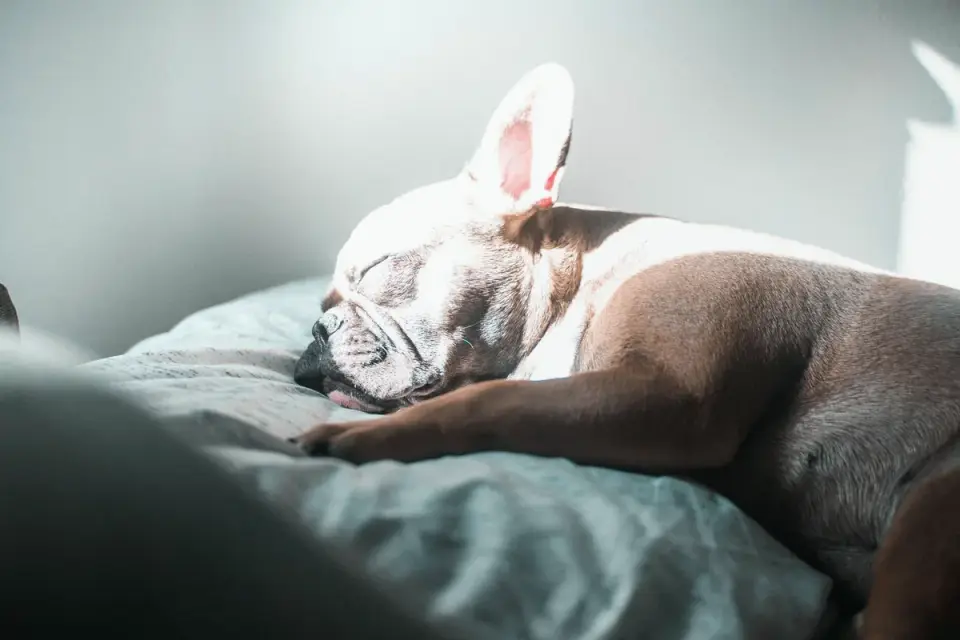
The counterargument worth taking seriously: some dogs really do seem to sulk in winter independent of any joint finding — same appetite, same gait, just flatter affect and less interest in play, in dogs with no orthopedic red flags at all. I don’t dismiss that. Boredom and understimulation are real, and a dog whose enrichment shrinks along with the daylight can genuinely look withdrawn. My answer there isn’t a supplement either; it’s rebuilding stimulation deliberately — a lunchtime walk, a snuffle mat, training reps indoors — before reaching for anything in a bag.
Building the winter routine, step by step
- Keep total daily movement roughly constant, even if you have to split it — a short midday walk plus a shorter evening one beats one truncated after-work loop.
- Add traction and warmth cues at points a stiff dog avoids: stairs, tile, the exit to the yard.
- Watch for the stiffness pattern specifically — slow to rise, loosens after a few minutes — and get that examined rather than assumed away.
- If anxiety, not stiffness, is the driver, evidence-supported options like L-theanine or KSM-66 ashwagandha are reasonable to discuss with your vet; chamomile is the gentlest and least proven of the group. Our broader roundup, Dog Anxiety Supplements: What Actually Calms a Nervous Dog, and What’s Just Marketing, scores the category on the same rubric.
- Rule out storm and darkness-specific triggers if the change is tied to weather events rather than the season broadly — that’s a different protocol, covered in How to Calm a Dog During Thunderstorms.
The bottom line
There’s no such thing as a diagnosed seasonal affective disorder in dogs, and I’d resist letting that label stand in for real detective work. What I’ve watched happen, winter after winter in my own caseload, is quieter: less light means shorter walks, shorter walks mean stiffer joints and less stimulation, and a dog that’s stiff and understimulated can look exactly like a dog that’s depressed. Start with the gait, not the mood. If the exam and the routine both check out and the dog is still flatter than usual, that’s when a calming ingredient with real data — L-theanine or KSM-66 ashwagandha, specifically — earns a place in the conversation. Not before.
Sources
- Chamomile evidence review — Biomedicines
- KSM-66 Ashwagandha systematic review — Cureus
- L-theanine anxiety review — Nature