Senior Dog Slowing Down? The Supplements With Real Evidence Behind Them
A veterinarian sorts the supplements for a senior dog that is slowing down by the sign you actually see — sore joints, a foggy brain, or low stamina — and shows what the controlled trials really found.
If your senior dog is slowing down, a few supplements can help — matched to joints, brain, or waning energy.

On this page
- Match the sign to the ingredient first
- Slowing down is several problems wearing one label
- Ingredients with real trial support for aging joints
- Ingredients with real trial support for an aging brain
- The longevity and NAD+ aisle: promising, thinner evidence
- Reading the label like a skeptic
- When a supplement is not the answer
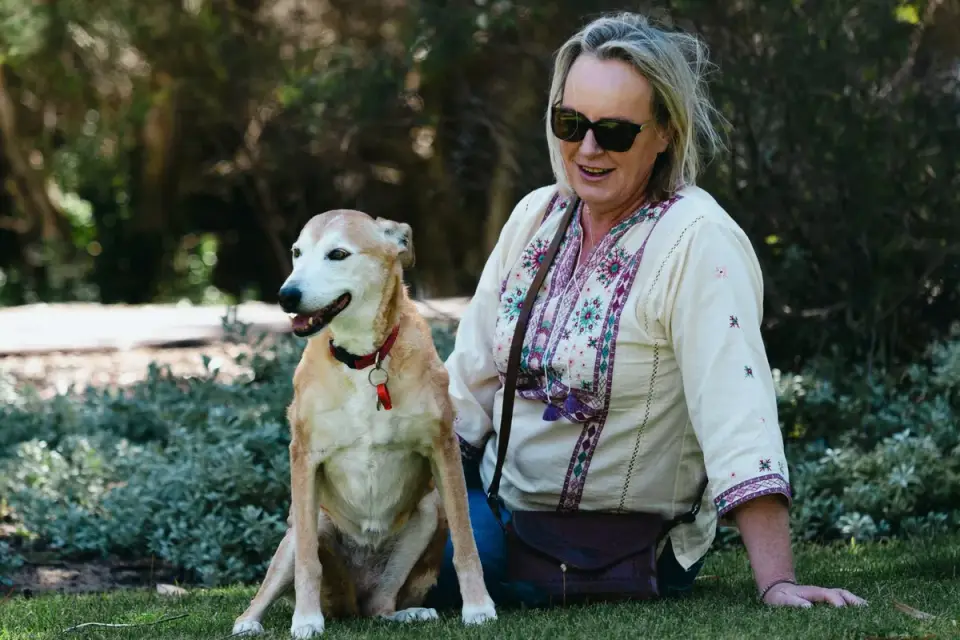
A dog who used to clear the back steps in one push now takes them one at a time. She sleeps longer, hesitates at the couch, and some evenings stands facing a corner as if she has lost the thread of the room. Owners reach for the phrase slowing down, and that one word usually bundles three separate physiological changes: joints that ache, a brain that burns fuel less efficiently, and the slow loss of muscle and cellular energy that comes with age. Each has its own body of evidence, and each answers to different ingredients. The practical question is not which supplement wins, but which sign you are watching.
Match the sign to the ingredient first
Sort what you are seeing into a category before you buy anything. The sections below expand each line.
- Stiffness, limping, slower on stairs, reluctance to jump: omega-3 fatty acids (EPA and DHA) carry the strongest trial support, with undenatured type II collagen (UC-II) and green-lipped mussel as reasonable additions.
- Disorientation, night pacing, staring at walls, lapses in house training: medium-chain triglycerides (MCTs), an antioxidant-enriched diet, and S-adenosylmethionine (SAMe) each have controlled canine data.
- Low stamina, dull coat, general fatigue: fix diet, body condition, and dental pain first; omega-3s help here too.
- Interest in NAD+ or longevity products: a fair thing to consider, held to a lower evidence bar than the joint and brain research.
- Anything new, fast, or dramatic: a veterinary exam comes first, because sudden decline can signal pain, thyroid disease, or heart failure that no chew corrects.
Slowing down is several problems wearing one label
Osteoarthritis is common in older dogs and shows up as a mechanical, weight-shifting gait. Canine cognitive dysfunction is a distinct neurodegenerative process, with brain changes — including beta-amyloid deposits — that parallel human aging. Age-related muscle loss is a third track that saps stamina on its own. The reason this matters is practical: an owner who buys a joint chew for a dog whose real problem is cognitive will see nothing change and conclude that supplements do not work. Sorting the sign is the first therapeutic step, not an afterthought.
Ingredients with real trial support for aging joints
Omega-3 fatty acids have the cleanest data. In a 2010 randomized, double-blind trial of 38 dogs with osteoarthritis, 82 percent of those fed a fish-oil-enriched food improved on peak vertical force — a force-plate measure of how much weight a dog will put on a sore limb — against 38 percent on the control food. In structure and function terms, EPA and DHA support comfortable weight-bearing.
Undenatured type II collagen (UC-II) is the next tier. A 2019 trial in 60 dogs pitted 40 mg a day of UC-II against the prescription anti-inflammatory robenacoxib over 30 days; owner-scored mobility improved by a similar margin in both groups for mild-to-moderate cases, and the drug pulled ahead only in the severe dogs. UC-II acts through oral tolerance rather than by blocking inflammation, so it works slowly and is no rescue for acute pain.
Green-lipped mussel rounds out the group. A 2013 study fed a mussel-enriched diet and recorded better force-plate weight-bearing and higher measured activity, alongside a rise in blood omega-3s. Part of that benefit rides on the same fatty acids, so stacking a separate fish oil on top of it adds less than the two labels suggest.
Ingredients with real trial support for an aging brain
Medium-chain triglycerides (MCTs) have the strongest cognitive signal. In a 2010 British Journal of Nutrition study, aged dogs on an MCT-supplemented diet made fewer errors as the cognitive tasks grew harder. The mechanism is plausible: an older brain handles glucose less well, and MCTs supply ketones as a second fuel.
An antioxidant-enriched diet is the next lever. A 2002 study built food around vitamins E and C, lipoic acid, L-carnitine, and fruit and vegetable extracts. Old dogs improved on progressively harder learning tasks while young dogs did not — the pattern you would expect if the diet counters age-related oxidative change rather than making any dog smarter.
SAMe has a smaller but controlled case. A 2008 double-blind trial gave 36 dogs 18 mg/kg of SAMe or placebo for two months, and treated dogs gained more on owner-rated activity and awareness. SAMe is better known as a liver support, and this cognitive signal comes from a single modest study, so I weight it accordingly.
The longevity and NAD+ aisle: promising, thinner evidence
Cellular NAD+ declines with age, and precursors such as nicotinamide riboside raise it in the laboratory. Most of the life-extension work still sits in mice, worms, and cell culture — the quercetin and resveratrol findings that longevity marketing leans on largely stop at the invertebrate level and have not been reproduced in dogs. One 2024 randomized trial in 70 senior dogs did find that a combined senolytic and NAD+ precursor product improved owner-rated cognitive scores at three months. That is a real signal, though it comes from a single trial of a combination product judged by questionnaire, which I read as a reason to watch the category rather than a settled answer.
Reading the label like a skeptic
The bottle matters as much as the ingredient. Four checks separate a serious product from a hopeful one.
- A dose that matches the studies: EPA and DHA in the hundreds of milligrams to a gram or more for a large dog, UC-II near 40 mg — not a trace sprinkled in for the label.
- An NASC quality seal, which means the maker submits to facility audits.
- A third-party certificate of analysis (COA) confirming the jar matches the label.
- Structure and function wording on the box; a product that promises to treat or cure arthritis is making a claim it is not permitted to make, and that is a warning sign rather than a feature.
When a supplement is not the answer
The critical-care habit is to rule out the treatable first. A dog who is slowing down may be in enough joint pain to need a prescription analgesic that no chew can match. Body weight is the single largest lever on an arthritic dog, and taking a few pounds off costs nothing. Hypothyroidism, heart disease, and dental pain each read as slowing down, and each has a specific treatment. Supplements belong on top of that workup, not in place of it.
Pick the one or two ingredients with data behind the sign you actually see, give the product eight to twelve weeks, and track something concrete — stairs climbed without stopping, nights slept through, how far the evening walk reaches. Bring that record to your veterinarian at the next visit. The senior dogs who do best tend to belong to owners who turned a vague sense of slowing down into a short list of things they could measure and revisit.
Frequently asked questions
How long before a senior dog supplement shows any effect?
Most of the joint and cognitive trials ran 30 to 90 days. Give a single product eight to twelve weeks and track one concrete sign — stairs, night waking, walk distance — before deciding whether it works.
Can I give my senior dog several supplements at once?
You can, but overlap wastes money and clouds the picture. Fish oil, green-lipped mussel, and many joint chews all supply the same EPA and DHA. Add one ingredient at a time so you can tell what is actually helping.
Are joint supplements as effective as prescription pain medication?
For mild-to-moderate stiffness, a 2019 trial found undenatured type II collagen roughly matched a prescription anti-inflammatory over 30 days. For a dog in more significant pain, the medication outperformed it, so supplements support comfort rather than replace analgesia.
Is a fish oil from the human aisle fine for my dog?
The active parts, EPA and DHA, are the same. The practical issues are dose and quality: match the amounts used in the canine studies and choose a product with a third-party certificate of analysis so the label reflects the contents.
Sources
- Evaluation of the effects of dietary supplementation with fish oil omega-3 fatty acids on weight bearing in dogs with osteoarthritis (Roush et al., 2010) — Journal of the American Veterinary Medical Association
- Dietary supplementation with medium-chain TAG has long-lasting cognition-enhancing effects in aged dogs (Pan et al., 2010) — British Journal of Nutrition
- Brain aging in the canine: a diet enriched in antioxidants reduces cognitive dysfunction (Cotman, Head, Muggenburg, Zicker, Milgram, 2002) — Neurobiology of Aging
- Effect of a diet enriched with green-lipped mussel on pain behavior and functioning in dogs with clinical osteoarthritis (Rialland et al., 2013) — Canadian Journal of Veterinary Research
- Evaluation of the effects of undenatured type II collagen (UC-II) as compared to robenacoxib on the mobility impairment induced by osteoarthritis in dogs (Stabile et al., 2019) — Veterinary Sciences
- Effect of S-adenosylmethionine tablets on the reduction of age-related mental decline in dogs: a double-blinded, placebo-controlled trial (Reme et al., 2008) — Veterinary Therapeutics
- A randomized, controlled clinical trial demonstrates improved owner-assessed cognitive function in senior dogs receiving a senolytic and NAD+ precursor combination (Simon et al., 2024) — Scientific Reports